
Event Recap: Baker Lake Town Hall (October 31, 2024)
- Dec 20, 2024
- 11 min read
Updated: Dec 23, 2024
Kivalliq Alternative Energy
December 20, 2024

Event Overview
Who: Kivalliq Alternative Energy
What: Town Hall #2 – Baker Lake Wind Energy Project
When: October 31, 2024*
Location: Recreation Centre, Baker Lake
Target Audience: Baker Lake community members
Attendance: Approx. 25 people*
*The Town Hall was postponed by 1 day due to a blizzard in Baker Lake. The new time coincided with both Halloween and Bingo night, resulting in a lower-than-expected turnout at the event.
Hosts:
Blaine Chislett, Energy & Sustainability Manager, Sakku Investments Corporation (SIC)
Dana May, Project Development Manager, Northern Energy Capital (NEC)
Ruben den Uyl, Renewable Energy Analyst, NEC
Summary of Town Hall Presentation
Kivalliq Alternative Energy (KAE), an Inuit led partnership between Sakku Investments and Northern Energy Capital, is exploring the benefits of a wind and energy storage project in Baker Lake.
The Project aims to generate locally-produced clean energy, reduce reliance on imported fossil fuels, and increase energy sovereignty, security and economic development in the Kivalliq Region.
Wind energy offers benefits, but trade-offs such as land disturbance during construction, noise, and potential interactions with wildlife must first be fully understood.
Project infrastructure includes 1-3 wind turbines with 46m-69m turbine height, a battery storage system, a new road and an electrical line to connect the Project to Baker Lake's grid.
Project capacity is 1-3 MW of wind energy with 1-3 MWh of battery storage. It is estimated to produce 5,000 MWh of renewable energy per year, meeting 40% of Baker Lake's total electricity demand (~300 homes) and displacing 1,160,000 L of diesel per year.
Two sites are currently being studied, north of the community along the AEM road. Site selection criteria consider wind speed, distance to objects, environmental impact, and wildlife concerns.
Community engagement is a key aspect, with ongoing opportunities for feedback and collaboration.
Project timeline includes community engagement, wildlife monitoring, final site selection, design and engineering, with target construction start planned for 2026.
Project Updates (as of October 2024):
Community engagement activities nearing completion
Wildlife monitoring program expected to conclude in November, with results to follow
Connection Impact Assessment underway with QEC
Energy 101 course planning underway. KAE continues to seek a community co-developer.
KAE identified three key topics to address based on questions from the previous town hall in July:
Click the arrows to view details
1) Impact of renewable energy on electricity rates

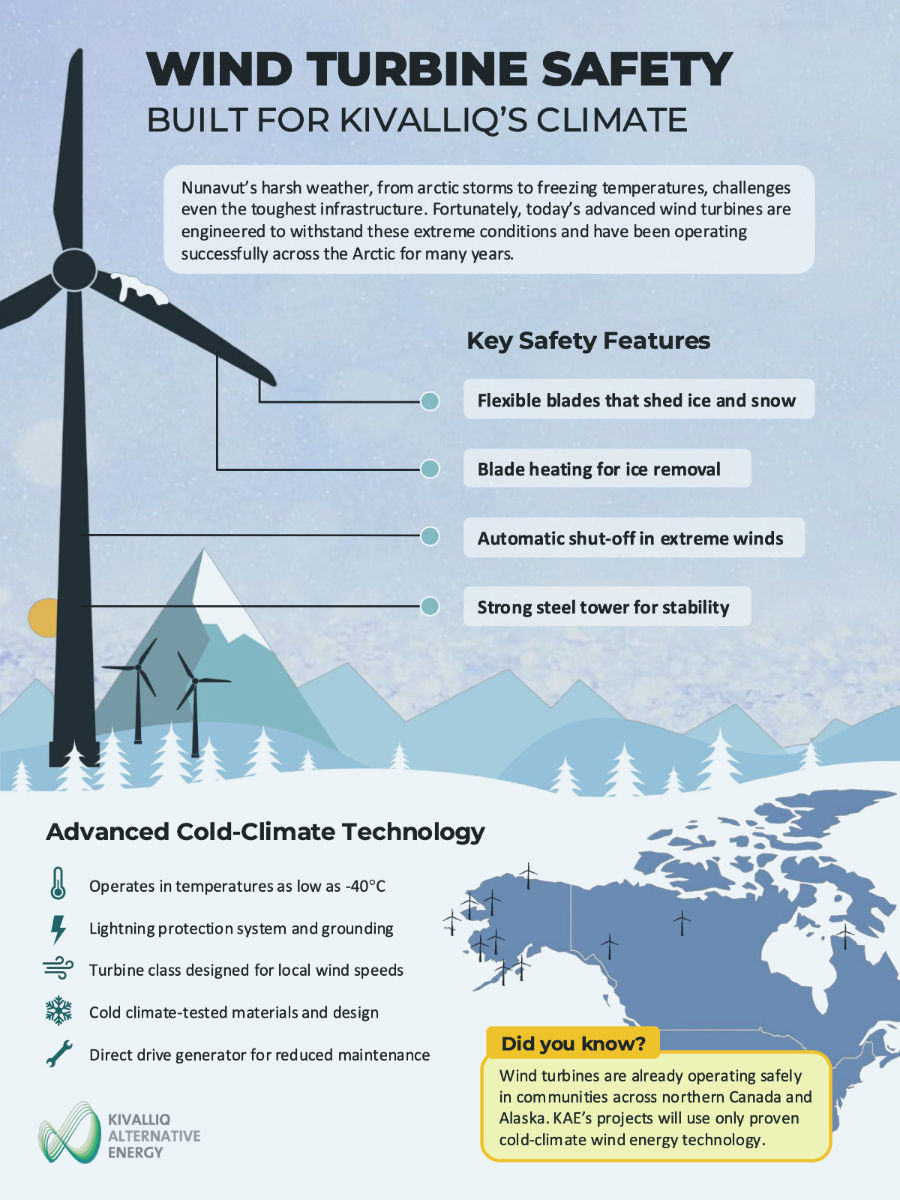
2) Wind turbine safety in Arctic conditions
3) Project Location and Wildlife Considerations
KAE is looking at two potential sites for the wind project north of the community along the AEM road. Work to date includes constraints mapping, group consultation sessions with Baker Lake's Hamlet Council, HTO, CLARC, youth council, and Elders (this trip), and a wildlife study (in progress).


What we learned so far
Wind speeds are suitable at both locations, and caribou migrate north of the community most times of the year.
Location 1 (closer to the community) is preferred due to no major physical limitations, environmental concerns, or community concerns.
Location 2 had some concerns raised by the community.
Next Steps
Analyze wildlife study results
Process community engagement feedback
Final project location selection
Archeological site assessment
Permitting process
NIRB application
Once approved, construction will start
Wildlife Study Results
The study is expected to conclude in November. The outcomes will be shared with Baker Lake's Hamlet Council, and a summary will be available on KAE's website. The public will be able to comment on the study and final outcomes.
Download Baker Lake Town Hall Presentation (PDF):
New Engagement Activities
KAE is committed to continually improving our community outreach tactics. Based on feedback received during the previous town hall in July, KAE added the following activities to our October trip:
Elders Meeting: KAE organized a luncheon for 12 Baker Lake Elders to present the proposed wind project, answer questions, and engage in knowledge-sharing discussions. Despite blizzard conditions, 10 of 12 invitees showed up. Elders received an honorarium for their time.
School Visit: KAE visited a Grade 9 class at the local high school to talk about careers in the renewable energy sector for a pilot curriculum program with EHRC's Bright Futures Energy Camp. Dana and Ruben were excited to talk to students and plant seeds for future skilled workers.
Radio Show: KAE hosted an hour-long radio show on Baker Lake's local station about the proposed wind project. The show was rescheduled for Oct 31 due to a blizzard on Oct 30.
Whisper Kits: KAE used personal audio devices (a.k.a. whisper kits) during the town hall to improve the translation experience for Inuktitut-speaking attendees. These devices allow the interpreter to translate live without pausing the presentation. The whisper kits were provided by KIA.


Kivalliq Alternative Energy team members Dana May and Ruben den Uyl visit a Grade 9 class to talk about careers in the energy sector for EHRC's Bright Futures Energy Camp, set up a Trick-or-Treat station for Halloween, and host a town hall to answer questions and gather feedback on the proposed wind energy project in Baker Lake, October 30-31 2024. PHOTO: Ruben den Uyl
Questions from the Community
Click the arrows to view KAE's responses
Q1: How much noise will the wind turbines produce, and what is the minimum required distance between the turbines and houses?
Response: Wind projects create noise within about a 500m radius of the turbines. When you are right next to a wind turbine, it generates noise levels similar to that of an idling truck or an ATV engine. As you get further away, wind turbines make less noise. At 300m away, sound levels are similar to that of a refrigerator, and at 500m away, noise levels are the same as average background noise, meaning it would not be discernible in most settings. When project locations are chosen, turbines are placed a minimum of 400-500m away from residential dwellings.
Q2: Will the wind turbines be effective in Baker Lake's harsh environment? How will they withstand extreme weather conditions?
Response: The wind turbines proposed for Baker Lake are designed to withstand extreme weather conditions, including extreme cold, arctic storms, and lightning strikes. Here's how:
Extreme cold: The turbines are designed to operate in temperatures as low as -40°C. The blades and other components are made of materials that can withstand these temperatures.
Arctic storms: The turbines are designed to withstand high winds and heavy snow loads. The steel towers are strong enough to withstand even in the strongest winds, and the blades are flexible to help shed snow and ice buildup. Blade heating systems also help with ice removal. If wind speeds become too high, the blades are equipped with an automatic shut-off mechanism and will stop spinning to ensure safety.
Lightning strikes: The wind turbines are equipped with lightning protection systems that ensure strikes travel harmlessly through the structure to the ground without damaging components.
In addition to these design features, the wind turbines are also tested in extreme weather conditions before they are installed. This testing ensures that the turbines can withstand the rigours of the Arctic environment.
Q3: How will the project help reduce electricity bills for homeowners?
Response: It is unlikely that any single renewable energy project would impact the local price of energy in the immediate term, as these rates are set by the Utility based on territory-wide operations costs, including fuel prices. However, what QEC can say for certain, is that renewable energy will not cause rates to go up. As an Independent Power Producer (IPP), KAE will sell electricity to QEC at the same rate as the 'avoided cost of fuel', which ensures that renewable energy projects under the IPP program remain cost-neutral.
In the future, when renewable energy becomes a larger portion of Nunavut's energy mix, QEC's rate structure will likely stabilize and potentially decrease over time. This is due to reduced reliance on external market price of diesel, and reduced wear on diesel generators resulting in lower operations and maintenance costs.
Q4: How will the wind energy project integrate with the existing diesel generators? What happens to excess energy if not needed, and how will the system respond to fluctuations in wind speed?
Response: The wind energy project in Baker Lake will include a large battery energy storage system (BESS). The batteries will store excess energy (charge) when winds are strong and energy production from the wind turbines is high. At times of low wind, when the energy production is low, the batteries will release stored energy (discharge). Renewable energy sources like wind can be intermittent, so this reservoir of energy storage provides a steady supply of power that helps to protect Baker Lake's grid from sudden drops or surges in power.
A battery storage system prevents the diesel generators from having to ramp up and down at fast paces, reducing generator inefficiencies. The batteries will have enough capacity to deliver energy for an hour, giving the generators plenty of time to safely and efficiently build up the required capacity.
Q5: How much will the project cost, and who is responsible for funding it?
Response: The cost of wind energy projects depends on many factors, including their size and location. The cost to build a wind project is higher in remote, northern communities than in other parts of Canada for several reasons: lower availability of specialized equipment that must be brought in, higher cost and complexity of logistics and shipping to remote areas, and materials and equipment that must be specially built to withstand the harsh Arctic climate. A 1MW wind project would cost approximately $17-23 million.
With financial assistance from Canada, the Project will be built, owned, and maintained by Kivalliq Alternative Energy (KAE). Under Qulliq Energy Corporation’s (QEC) Independent Power Producer policy, KAE is a non-utility, Inuit entity that will produce and sell electricity to QEC. By selling electricity to QEC, KAE will maintain the facility, hire operators and maintenance personnel, and expand the renewable energy capacity and skilled labour force for the region's clean energy future.
Q6: How will the project's turbines and batteries be disposed of at the end of their lifecycle, and who is responsible for it?
Response: Wind energy projects have an average lifespan of 25 years. This is based on the operable lifespan of the wind turbine equipment, which experiences wear and tear and increased maintenance needs over time. Once a wind energy project reaches end of life, it may either be re-powered, or decommissioned. Decommissioning involves disconnecting the project from the electrical grid, removing all associated structures and equipment, and returning the land to its previously undisturbed state. In both cases, removal and recycling of a portion, if not all, of the project is required.
Wind turbine components require extensive planning to decommission and include the use of a crane. Steel tower components can be disassembled, shipped south and recycled as scrap. Wind turbine blades, which are made of fiberglass, are typically broken down and landfilled. However, there is considerable progress being made in creative reuse programs for turbine blades which diverts them from landfill. Infrequently, turbine components may be donated to other groups for refurbishment and reuse.
Q7: What kinds of job opportunities and skills training will be available for community members as part of the project? Will there be training/employment opportunities after construction?
Response: KAE anticipates job opportunities for the community in both the construction and operation phase of the project. It is one of KAE’s core objectives to generate local jobs. We strive to not only supply the jobs, but also the required training to execute the job, so (the lack of) previous education doesn’t become a barrier for accessing these jobs.
Depending on the project progress, these job opportunities will be available to the community. KAE intends to hold a job fair in the community at that time. Our current estimation is that this would occur in the second half of 2025, with Spring 2026 being the start of the first jobs.
KAE is also developing an introductory Energy 101 course with the aim to educate everyone that is interested in renewable energy. This course will be co-developed between Yukon University and community representatives, to ensure the course reflects the needs, values, and circumstances of Baker Lake's community.
Internships may be possible throughout the project, and we will be looking into this in the future.
Q8: How will youth be engaged throughout the project?
Response: We are engaging with youth on different levels. First of all, we are in contact with the Youth Council of Baker Lake to hear their views and perspectives on the project. Secondly, we’ll be engaging with the schools in the community, to educate about energy and hear from the children in the school. Thirdly, all our public engagement sessions are open to all of the public and we highly encourage youth to participate and engage with us during these moments.
Q9: How is project data collected and shared with the community?
Response: KAE collects and shares project data to ensure transparency and community involvement. Wind data in Baker Lake was gathered during a year-long wind resource assessment study in 2022/23 using a SoDAR remote sensing device. This data was analyzed, and an energy yield assessment was conducted and presented to the Hamlet Council for feedback.
To better understand wildlife patterns near the potential wind turbine locations, KAE launched an exploratory Wildlife Monitoring Program in 2024. This program focused on documenting the presence and movement of barren-ground caribou, migratory birds, and any other species at risk in areas being considered for wind turbine installation. Survey stations with remote cameras and Automated Recording Units (ARUs) were installed at three locations in Baker Lake, approximately 2-5 km from the community. These stations were active from June to October. The findings will be presented in a report to Council, and made available for public viewing on KAE's website and through subsequent community engagement sessions.
Community feedback is also an essential part of KAE’s data collection. Input is gathered through anonymous surveys and engagement sessions, where responses are recorded. This feedback is shared with community members via KAE’s website, social media channels, and follow-up engagement sessions. In addition to local sharing, KAE will also disseminate project data across the Kivalliq region through workshops, conferences, and publications.
Q10: Could the project have negative impacts on the people of Baker Lake?
Response: While a wind energy project will offer many benefits for Baker Lake, including clean energy generation and reduced reliance on fossil fuels, there are potential impacts to consider. These may include land disturbance during construction, noise produced by the turbines, and possible interactions with wildlife.
Wind projects require space, which can displace existing use of the land by wildlife or humans. Selection of land is carefully considered to minimize impacts to habitats and land users. Although construction inevitably causes some temporary land disturbance, remediation efforts will be undertaken to restore the land wherever possible. Wind turbines do produce noise, but levels decrease significantly with distance. KAE ensures turbines are placed a minimum of 400-500 meters away from residential areas to mitigate noise pollution.
There is a risk of potential impacts on wildlife, particularly birds, bats, and caribou, with a wind energy project in Baker Lake. The community is situated close to important caribou migration routes, which are vital to the Kivallirmiut for food and cultural practices. To minimize possible impacts, KAE is conducting extensive monitoring studies and engaging with community members and wildlife experts. The goal is to locate the wind turbines away from major migration pinch points, flight paths, and sensitive areas like calving grounds. While some overlap with caribou travel routes may be unavoidable, strategic turbine placement will help ensure the project successfully coexists with wildlife and the environment.
Feedback from the Community
Town hall attendees seemed to agree with Location 1 as the preferred project site, and no additional concerns were raised when discussing the estimated noise levels or size of the wind turbines.
The Elders who were invited to the lunch explicitly remarked that they appreciated the chance to be involved in the development process, and all were in favour of renewable energy initiatives in the community.
General remarks from the Elders lunch noted that the Baker Lake community is tired of buying from the south and want to start producing and selling locally. They also expressed concern for the local capacity and work ethic in the community, and whether KAE's project will address this issue.
Elders wondered if there was a high request for help among the community with residential solar PV projects (via QEC's Net-Metering Program), noting that people could use some assistance accessing grants, filling out applications, and ordering/installing the equipment.
About Kivalliq Alternative Energy
Kivalliq Alternative Energy (KAE) is a leader in the clean energy transition in Nunavut's Kivalliq region. By developing renewable energy-generating projects, KAE is increasing energy independence for the remote communities it represents. KAE's projects nurture community benefits, grow local capacity and lay the foundations for powering the region's clean energy future. KAE is an Inuit-led partnership between Sakku Investments Corporation (SIC) and Northern Energy Capital (NEC).
Follow Us
For project updates and upcoming events, follow KAE on Facebook: KivalliqAlternativeEnergy


